In early August, Astrid Arnheim Bonnier spent four days in Helsinki as the Centre for European Policy began building its new presence in the Nordic Countries. In this report, she reflects on the meetings, impressions, and questions that shaped her first visit.
Monday: Across the Baltic to Helsinki
There are probably more conventional ways to start an internship at a European think tank than arriving by ferry. On Monday, 3 August, I reached the Finnish capital aboard Silja Line after crossing the Baltic Sea. Helsinki greeted me with mild temperatures, a welcome contrast to the weather extremes experienced elsewhere in Europe this summer. More importantly, the trip marked my first opportunity to meet my supervisor, Dr. Anselm Küsters, in person. He is Head of the Division for Digitalisation and AI at the Centres for European Policy Network, and, more recently, its Scientific Director for cep Nordic Countries.
Since this summer, Anselm has been leading the establishment of this new hub for the Nordics, which will be based in Helsinki. The main idea behind this addition to the cep network – which already covers France and Italy with colleagues in Paris and Rome, respectively – is to bring Nordic and Baltic perspectives more directly into the European policy debate. This is particularly relevant for questions of digital transformation, innovation, and societal resilience, where there is much to learn from the Nordics. From the beginning, I have been convinced that this idea indeed matters and have thus been looking forward to my internship, hoping to contribute where I can and to learn along the way.
I spent the rest of Monday getting an initial sense of how cep operates as a decentralised European think tank. Anselm introduced me to the structures behind the organisation’s day-to-day work and publication process, giving me a clearer picture of how colleagues across different offices coordinate their work. Before turning to policy questions over dinner, this provided a useful first insight into how a European think tank functions across borders.
Tuesday: Who is who in Finnish digital policy?
On Tuesday, Finnish policymaking was on the agenda at the Ministry of Transport and Communications. Together with Anselm, I had the pleasure of meeting Maria Rautavirta, Director of Data Business Unit at the Ministry. The meeting gave us a picture of Finland’s digital and AI policy landscape. Maria Rautavirta has spent close to three decades working in Finnish digital policy and knows the landscape well, who the key stakeholders are, how responsibilities are divided, and which political priorities currently guide the government’s work.
Finland is a digital frontrunner in Europe with an impressive technological heritage. Linux, created by Finnish programmer Linus Torvalds, has become one of the world’s most widespread operating systems, powering billions of devices when Android is included. It has also played a major role in the growth of open-source software, a technology that Anselm has repeatedly championed in his work for cep. Since my partner introduced me to Linux, I use it daily on my laptop. Nokia, Secure Shell (SSH) for secure data communication between computers, and MySQL, a system for managing data, all have roots in Finland. Nokia’s collapse was a national trauma, but our meeting with Maria showed me how Finland has since recovered and reinvented itself. During the past few years, Maria has worked on Finland’s Digital Compass, the national strategy for meeting the EU’s digitalisation goals by 2030 and keeping Finland at the forefront of Europe’s digital economy.

Wednesday: Europe’s competitiveness problem, seen from Helsinki
Wednesday offered a closer look at Finland’s technology and business landscape, as we visited Quanscient Oy, a Finnish tech company working with cloud-based simulation, AI and quantum computing. Jaana Komscha-Härkönen, VP of Strategic Partnerships and External Relations at Quanscient, met us for coffee and told us about the company. For me, the most interesting part of our discussion concerned competitiveness: Finland has strong technical expertise, but firms do not always have access to the capital needed to scale into globally leading companies. This challenge extends beyond Finland. Europe produces skilled researchers, engineers and innovative start-ups, but has been less successful at turning that strength into companies capable of scaling globally.
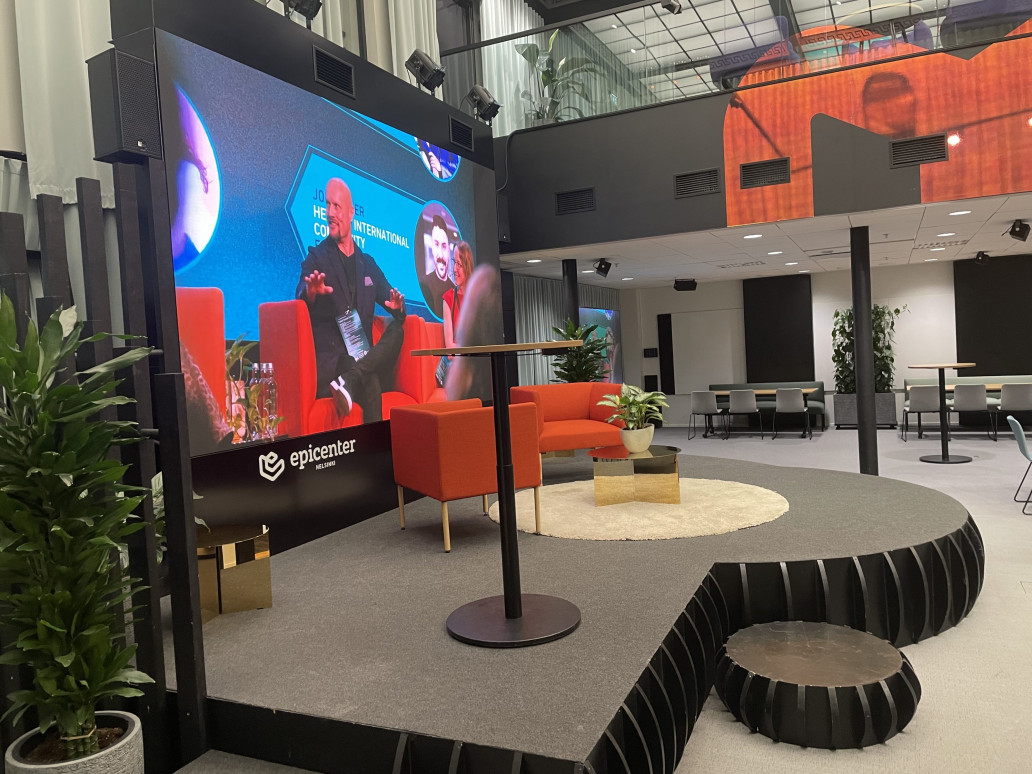
The financing gap has moved higher on the European policy agenda, as we told Jaana during our meeting. During the same week of my stay in Helsinki, the European Commission completed the final legal steps for the new Scaleup Europe Fund. The fund targets €5 billion and is intended to provide growth-stage financing for European tech companies, including AI, quantum technologies, semiconductors and robotics. The fund is run by Sweden’s EQT, and its first public investment was the Finnish satellite company ICEYE. Fittingly, our conversation took place at the Epicenter, a startup and innovation hub located in the heart of Helsinki. Surrounded by the bustling activity of young firms, we discussed how they can grow, and it quickly became clear that Finland’s wider tech and startup scene would provide ample opportunity to gather insights that could be transferred to Germany.
Thursday: from AI datacentres in space to Finnish art
Together with Anselm, I reviewed his forthcoming essay on AI data centres in space and the case for a liberal vision of the space economy, written in the context of the EU’s planned Space Act. Working through the argument and structure gave me a useful insight into policy writing: how technically grounded analysis can remain accessible to a broader readership without losing precision.
Before heading to the airport, I visited the Ateneum, Finland’s national gallery, and its exhibition on Finnish artist Eero Nelimarkka. Nelimarkka was an avid traveller. Alongside Finnish landscapes and people, he painted what he encountered on journeys across Europe. It felt like a fitting way to end my trip to Helsinki: a reminder of the importance of going somewhere, seeing it for yourself and encountering perspectives that are difficult to understand from a distance.
Outlook
The week gave me a broad view of Finland’s digital and innovation landscape. At the Ministry, we heard how Finland approaches digital and AI policy. At Quanscient, we discussed the challenges facing innovative European companies. These conversations showed why it is useful for cep to have a presence in the region. In particular, cep Nordic Countries can help connect these local perspectives with wider European debates. That means speaking with policymakers, companies, and researchers in the Nordic and Baltic countries, understanding the challenges they face and bringing those insights into cep’s work at European level.
My first days as an intern in Helsinki gave me a much clearer idea of what cep Nordic Countries can contribute. The next step will be to turn these first contacts and impressions into lasting links between the region and the wider European policy debate. Nelimarkka travelled through Europe and brought what he saw back to Finland; our task is the same journey in reverse.

Copyright Header Picture: Shutterstock / Other Pictures: Own one.