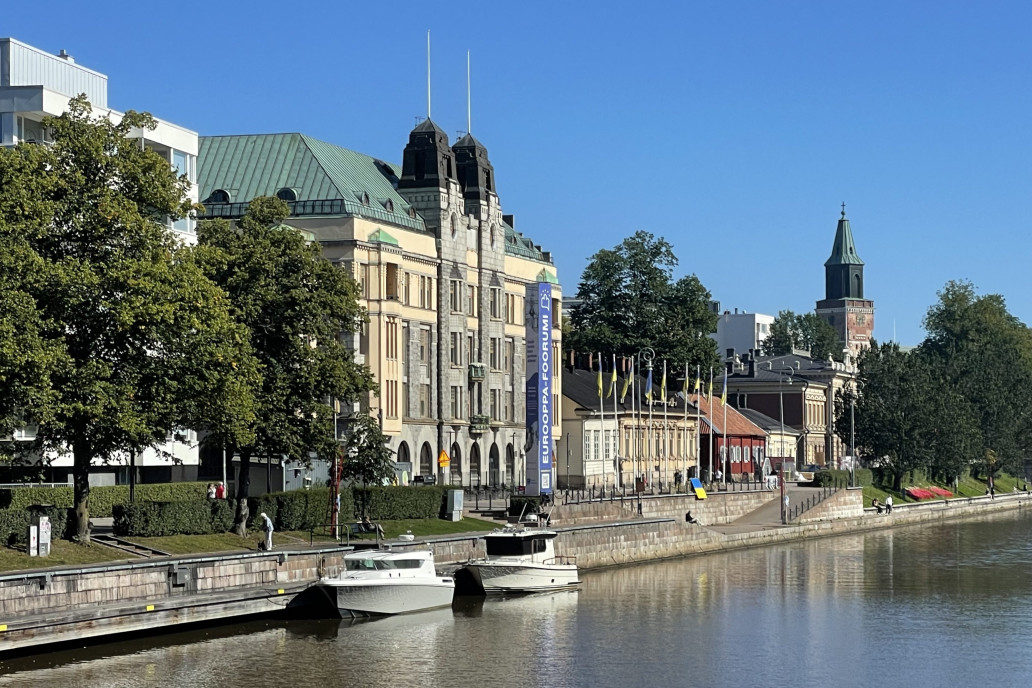
Manufactured in Helsinki, Coveted in Washington, and Denied to Moscow: Finland’s Icebreakers Offer Valuable Lessons for Europe’s Quest for Greater Sovereignty.
Every summer, Finland parks its winter insurance policy in the middle of its capital city, yet almost no tourist walking past recognises it as a strategic asset. Arguably, the rows of icebreakers at Katajanokka are one of Europe’s most instructive chokepoints, carrying lessons for the current debate on achieving more resilience. Dependency only becomes a weapon when certain conditions are met simultaneously. In the case of Finland’s icebreakers, these conditions are met on a scale of a few hundred engineers, one design office, and a refrigerated model basin. We do not always have to think on the scale of a cutting-edge semiconductor fab when it comes to European sovereignty.
The row at Katajanokka
I came across the ships on foot in the early days of setting up our new cep network node in Helsinki, cep Nordic Countries. They are hard to miss. From the quay, you can mostly see a wall of steel, including orange lifeboats, and, painted along the superstructure, the web address of the state-owned company Arctia. The latter operates eight icebreakers, namely Polaris, Otso, Kontio, Voima, Urho, Sisu, Fennica, and Nordica, as well as the harbour icebreaker Ahto. Polaris, the world’s first icebreaker to use LNG as fuel, is the most recent addition to the fleet. The ships are usually at home in the summer months. When passing by, you can watch a fleet that exists to ensure a country can continue to receive and send goods in February, resting just a short walk from the traditional market square.
When taking a boat tour next to them, as I did a few days later, you will notice the beam. The hulls are wide relative to their length because they have to repeatedly open a channel wider than themselves for subsequent merchant fleets to pass through on schedule. The forthcoming icebreaker Aino, recently ordered as a replacement, will be about 96 metres long and 24 metres wide, and will cut a channel roughly 25 metres wide. Aino will replace Voima, which was commissioned in 1954 and is still the oldest icebreaker in active service anywhere.
The names are also worth a mention. “Otso” and “Kontio” are old Finnish words for “bear”, “Voima” means “strength”, and “Sisu” needs no translation for anyone who has spent a winter here. A country that names its infrastructure in this way is revealing how it perceives the thing being protected.
A hundred winters of accumulated data
Finnish harbours essentially freeze over every winter, and more than 95 per cent of Finland’s foreign trade in goods moves by sea. Depending on the severity of the ice, vessels require assistance between 300 and 3,000 times per season. The mild 2024-25 season ran for 153 days. Icebreaking is procured by the Finnish Transport Infrastructure Agency and operated under contract by Arctia and, for tug-based assistance, Alfons Håkans, a sixth-generation, Finnish family-owned company. The business is largely covered by fairway dues paid by arriving ships and coordinated with Sweden through jointly agreed ice classes and assistance restrictions.
Out of this permanent domestic requirement grew a unique export position. According to Business Finland, Finnish companies have designed around 80 per cent of the world’s icebreakers, with Finnish shipyards building around 60 per cent of them. Today, this capability, which goes back to 1910 when the first icebreaker was built in Helsinki, is mainly concentrated in four places: the Hietalahti yard in central Helsinki, which has been building ships since 1865 and now operates as DNY Finland Oy; Rauma Marine Constructions on the west coast; Sata Shipbuilding in Mäntyluoto, Pori, which handles steel and block production for the Helsinki yard; and Aker Arctic, formerly the research unit of Wärtsilä, whose sub-zero laboratory in Helsinki tests scale hulls in a roughly 70-metre ice tank. The scarce input for this industry is not welding capacity, but rather the accumulated experience of operating ships in winter and the steady feedback of crews.
By contrast, ownership has been anything but stable. The Helsinki yard has passed through the hands of Wärtsilä, Masa-Yards, and STX, before being sold to Russian investors in 2010. It then passed to the Cyprus-registered Algador Holdings, the main shareholder of which is Vladimir Kasyanenko – a businessman with alleged close ties to the Russian Federation – before finally being sold to Davie in Canada in November 2023. This last transaction was partly financed with 77 million euros from the government of Quebec. The same yard, now operating as DNY Finland Oy, has begun work on the Arctic Security Cutters for the US Coast Guard, seemingly one of the first tangible outcomes of the Icebreaker Collaboration Effort, a trilateral partnership between the US, Canada, and Finland that aims to strengthen Western icebreaking capabilities and Arctic security. In the summer of 2026, it was also selected by the Finnish Transport Infrastructure Agency to build the above-mentioned Aino, with 42 million euros of support from the EU’s Connecting Europe Facility.
Defining chokepoints
In EU policy circles, everyone now uses the term “chokepoint”, but they often have different meanings in mind. A recent conference presentation by Simon Fuchs, Fernando Leibovici and Woan Foong Wong helpfully distinguishes between three dimensions. First, “exposure” is how much of your trade relies on a given link. Second, “disruption” is the cost to you after rerouting, switching suppliers, running down stocks, and paying more following a cut. Finally, “vulnerability” is whether the link can be used against you by others, which depends on their arithmetic rather than yours alone.
In other words, the first dimension of a chokepoint tells you very little about the second. According to the researchers’ calculations, closing the Suez and Red Sea corridor raises the traffic-weighted route distance of affected lanes by around 121 per cent, whereas closing the Strait of Malacca raises it by only around 18 per cent. Across the network, there is little correlation between traffic volume and detour severity. Heavily used links often have cheap substitutes, and links that are expensive to bypass often carry little that matters. Measuring how much passes through a node, what most economic security screening does, is thus measuring the least informative of the three dimensions.
In times of high geopolitical tension, when “hybrid threats” to Europe may suddenly escalate, this framework can also inform game-theoretical considerations. In short, an adversary compares their loss to yours and acts only when their political valuation of hurting you exceeds a threshold set by that ratio. This idea of vulnerability can be traced from Albert Hirschman’s work on asymmetric dependence to more recent work on weaponised interdependence. For policy, it follows that a dependency that can be measured exactly in numbers may be strategically irrelevant, while one that has barely been considered – such as icebreaking expertise – may be more decisive.
Applying the chokepoint framework to the ice
First, consider exposure in both directions. Finland’s exposure to winter navigation is almost total: every port freezes, most goods are traded by sea, and hard winters mean thousands of assisted transits. The world’s exposure to Finland is more limited, but concentrated in design and specialised construction. This is evident in the order book, as a Canadian polar icebreaker and American cutters are being built in Helsinki, while Finland is renewing its own fleet.
Now consider the disruption elasticity. If Finnish shipyards and designs were to become unavailable, countries would need to somehow get alternative icebreakers. They would build them later, at a higher cost, and, most importantly, with a steep learning curve to overcome – and all of this just as climate change is opening up new Arctic sea routes, pushing the demand for icebreaking capacity up. The revealing detail is that in the recent American-Finnish deal, Washington accepted the construction of the first hulls abroad because the domestic alternative could not meet the schedule. Of the eleven Arctic Security Cutters ordered by the US Coast Guard, four are being built in Finland: two at Rauma Marine Constructions, and two at Helsinki Shipyard. Announcing the Rauma contract, RMC’s chief executive Mika Nieminen noted: “We secured this significant deal thanks to our expertise and capability to build the ships within the required timeframe”. The first cutters are due in 2028, with the remaining seven built later in Louisiana and Texas. In other words, a substitute exists, but it is priced in years. This is what moderate but real disruption elasticity looks like. Note, however, that selling the capability to allies also spends it: Every hull assembled abroad alongside Finnish builders reduces the future disruption elasticity.
The third condition, vulnerability, has already been tested following Russia’s attack on Ukraine. In late September 2022, the Finnish Ministry for Foreign Affairs refused an export licence to Helsinki Shipyard for an LNG-powered icebreaker that had been ordered by the Russian mining firm Norilsk Nickel for use in northern Siberia. This decision brought an end to a project that was expected to generate approximately 2,100 person-years of employment within the shipbuilding and maritime industries. We can read this through the cutoff logic introduced above: the harm to Russian Arctic logistics was high, the political value of inflicting it was high, and EU sanctions supplied both the legal instrument and the coalition cover that lowered the domestic cost of pulling the lever. As this shows, a united European coalition helps to move the threshold at which a cutoff threat becomes rational.
Implications for European sovereignty
Faced with a persistent polycrisis, the current thinking in Brussels is to “go big”, as exemplified by the Chips Act or the AI Gigafactories: think a cutting-edge chip factory, or a completely sovereign cloud. However, these are hugely expensive areas in which European disruption elasticity is poor. The three-condition test by Fuchs, Leibovici and Wong points elsewhere: Ask yourself where a capability is repeatedly, and predictably, relied upon, hard to substitute within a relevant timeframe, and controlled by someone whose cost of withholding it is low. These conditions are often met at a small scale: in test facilities, specialised toolmakers, long-lived operational datasets – or Finnish icebreakers.
In addition, the Finnish arrangement also provides an ordoliberal lesson in ownership. The state does not own the shipyard, as many proponents of industrial policy would call for. Instead, it owns the demand and the rules: procurement is handled by the Transport Infrastructure Agency, financing comes from fairway dues, ice classes are coordinated with Sweden, and the state has demonstrated its willingness to use its export licensing power. The yard itself is privately and foreign-owned.
Despite much progress over the past few years, the EU’s economic security instruments, ranging from investment screening to dependency mapping, primarily measure trade shares. This means they focus on assessing exposure, but not the other dimensions of modern chokepoints. A serious inventory would ask further questions: Which of Europe’s small, unglamorous competences would genuinely hurt if they were withdrawn? And who, apart from us, has already done that calculation?

Copyright Header Picture: Private picture, Anselm Küsters.